

What is a Class-A fire-rated shingle? Is a Class-A fire rated shingle good or bad? What wind speed can a Class-H shingle withstand? Is a Class-4 impact resistant shingle the best or the worst? Below, you’ll find roof codes and classes explained. You’ll also find a brief, simple explanation of what each class is and which rating is best. We also list which roofs are Class-A fire-rated, Class-3 and 4 impact rated, as well as note which roofs have the highest wind rating.
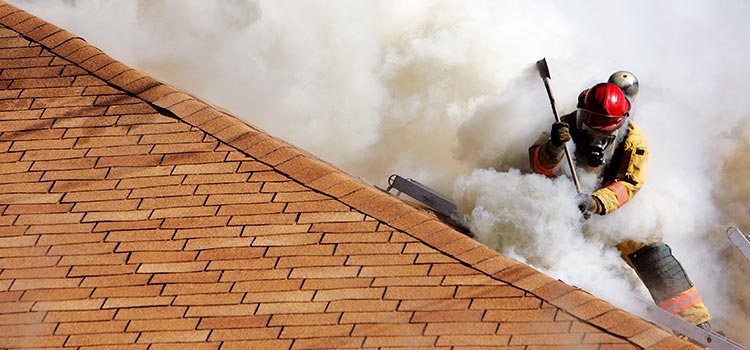
Roof Fire Resistance Classes Explained
The UL 790 (ASTM E 108) classification is a standard fire test. It tests how resistant a roof is to simulated fire. This test is conducted from above the roof and not from below, such as from within your home. Roof fire-resistance is rated on a scale from C to A, A being the best and resistant to severe fire exposure. Class-C fire rating is resistant to light fire exposures.
You want a Class-A fire-rated roof, and, thankfully, all asphalt shingles and steel roofs are Class-A fire-resistant.
- UL 790 Class-A effective against severe fire test exposures
- UL 790 Class-B effective against moderate fire test exposures
- UL 790 Class-C effective against light fire test exposures
Class-A Fire-Rated Roofs
All Owens Corning, GAF, Tamko, CertainTeed, IKO, and Malarkey asphalt roofing shingles are Class-A fire rated. In addition, all metal roofing, including metal shingles and standing seam, are Class-A fire rated. Not all clay roofing tiles are Class-A fire rated. If you’re interested in a Class-A fire-rated clay roof, contact us. Most concrete roofing tiles are Class-A fire rated. If you’re interested in a Class-A fire-rated concrete roof, contact us so we can help you find one. We offer quality clay and concrete roofing tiles from Westlake Royal Roofing.
Best Fire-Resistant Roof
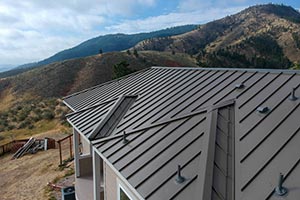
Any metal or steel roof will be the best fire-resistant roof. This includes our own standing seam metal roofing panels, and stone-coated steel shingles, shake, and tiles from Decra and Westlake Royal Roofing. Real wood shake is the least fire-resistant.
Need help choose a fire-resistant roof?
Contact us for a free chat.
Roof Impact Resistance Classes Explained
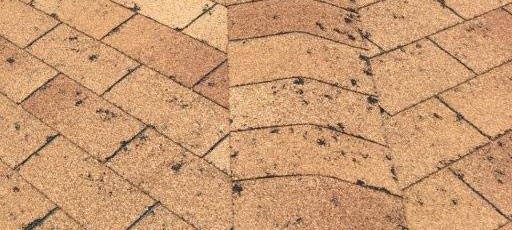
Roof impact ratings are technically broken-down into 4 classes from Underwriters Laboratories (UL): 1, 2, 3, and 4, with 4 being the highest and 1 offering the least impact protection. However, we’re not aware of any roof covering that only meets class 1 or 2. To achieve a Class-4 rating, shingles must endure the impact of a 2-inch steel ball dropped from 20 feet without showing any signs of damage. To achieve a Class-3 rating, shingles much endure the impact of a 1 & 3/4″ steel ball dropped from a height of 17′. Class-2, a 1 & 1/2″ steel ball from 15′. Class-1, a 1 & 1/4″ steel ball from 12′.
You want at least a Class-3 impact rated roof in Colorado because hail storms we get, preferrably a Class-4.
Since a Class-4 impact rated roof covering offers the best protection from hail, if you live in an area of Northern Colorado that’s prone to frequent or large hail, this classification of roof is recommended. However, if you live in a part of Colorado that’s gets smaller hail, a roof with a Class-3 impact rating may be sufficient.
It’s worth noting that most Class-4 impact rated roofs also perform better in high-winds and last longer. Often, the price difference between a Class-3 and a Class-4 shingle is minimal and worth the upgrade.
- UL 2218 Class-4
- UL 2218 Class-3
Class-3 Impact-Resistance Roofs:
Owens Corning
Duration
Duration Designer
Tamko
Titan XT
GAF
Timberline HDZ RS
Timberline UHDZ
Camelot II
Woodland
Grand Sequoia
Certainteed
Landmark
Landmark Pro
Belmont
Presidential Shake
Presidential Shake Solaris
Highland Slate
IKO
Dynasty
Armourshake
Royal Estate
Cambridge
Class-4 Impact-Resistance Roofs:
Owens Corning
Duration Flex
Duration Storm
Tamko
Stormfighter Flex
GAF
Timberline AS II
Grand Sequoia AS
CertainTeed
Landmark ClimateFlex
NorthGate ClimateFlex
Belmont IR
Grand Manor
Carriage House
Presidential Shake IR
Presidential Shake TL
Landmark TL
IKO
Nordic
Crown Slate
Metal Roofing
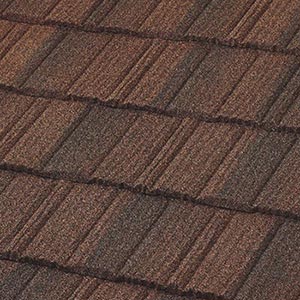
Metal roofing, such as stone-coated metal shingles and shake from Decra and Westlake Royal Roofing are all Class-4 impact rated. As well as our own standing seam metal roofing panels.
Best Impact-Resistant Roof
Any metal roof is going to be the best impact-resistant roof. This includes standing seam and stone-coated steel shingles, shake, and tile. Although metal roofs come with the same Class-4 impact rating as traditional asphalt shingles, they are offer better impact-resistance because metal is stronger and more resistant to impacts than fiberglass.
Need help choosing an impact-resistant roof?
Contact us for a free chat.
Roof Wind Classes Explained

Shingle roof wind ratings indicate the maximum wind speed a roof covering, such as asphalt shingles, will stay down and resist being damaged or blown off. The scale is from A, the lowest at 60mph to H, the highest at 150mph. Common ratings are A, D, F, and H.
Some roofs can offer two wind resistance ratings. For example, all of GAF’s asphalt shingles are both Class-F and H wind rated. To achieve the higher wind rating, additional materials are installed.
All of Owens Corning’s asphalt roofing shingles offer Class-F 110mph wind rating. However, some are more wind resistant than others, such as their Duration Flex and Storm lines. Tamko’s Heritage shingles are rated up to 110mph, while their Stormfighter Flex are rated up to 160mph.
Metal roofing, such as standing seam and stone-coated metal shingles, are often wind-rated at 140mph or higher. This is largely due to the fasteners used during installation. Metal roofing uses screws during installation. While asphalt shingles use nails. Screws offer much better holding power than nails and better resist pull forces.
- Class-H (up to 150mph)
- Class-G (up to 120mph)
- Class-F (up to 110mph)
- Class-D (up to 90mph)
- Class-A (up to 60mph)
Wind – ASTM D7158, Class H are rated to withstand winds of up to 150 MPH
Wind – ASTM D3161, Class F are rated to withstand winds of up to 110 mph
If you live in a part of Colorado that is prone to high winds, a Class-F or higher wind rated roof is strongly recommended.
Best Wind-Resistant Roof
The best wind-resistant roof is the one that uses screws to install it and has fewer seems for wind to grab and lift, and that’s any metal roof, such as stone-coated metal shingles, shake, and tile, as well as standing seam metal roofing panels. We form and cut your new standing seam panels for a perfect fit to your roof. Fewer seams means fewer opportunities for leaks and for wind to get under.
Ready for your new roof?
Contact us for a free estimate.
The Bottom Line
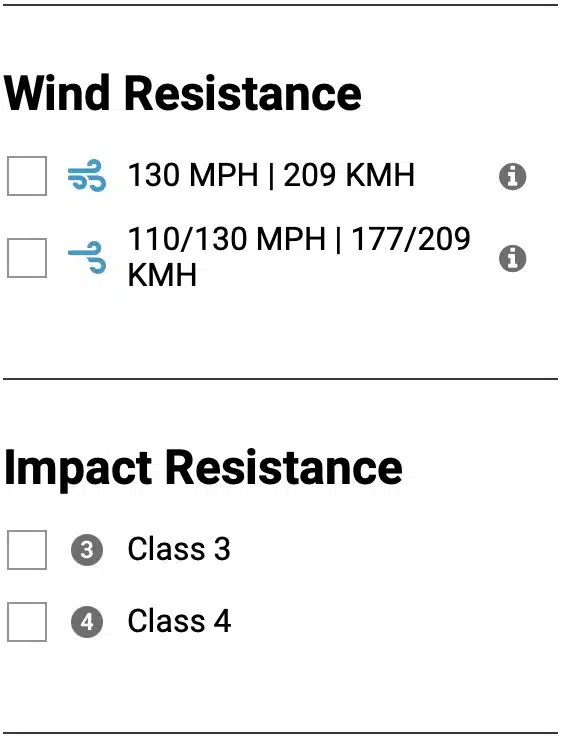
Roof codes and classes can be confusing. That’s why we explain them here as simply as we can. Some roof material manufacturers make it clear on their website which shingles are Class-4 impact rated, which are Class-A fire rated, etc. However, some do not. Owens Corning’s website, as well as GAF’s, allows you to only see Class-3 or 4 impact rated, or high wind resistant shingles, which is nice. Tamko’s website shows you the impact and wind rating on the first page.